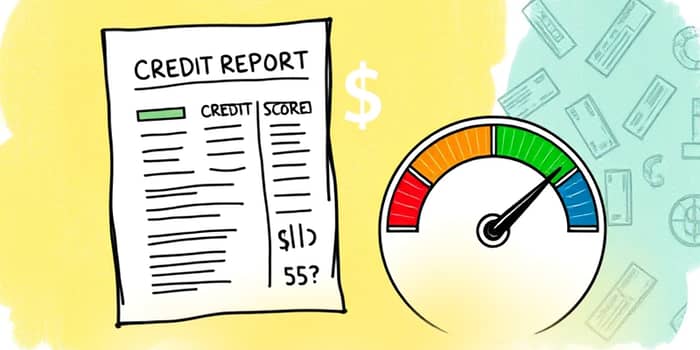
Understanding the distinction between a credit score and a credit report can transform how you manage your financial life. While they are closely related, each serves a unique purpose in shaping your borrowing power and long-term financial health.
A detailed account of your credit history is found in your credit report. It chronicles your financial behavior over the last seven to ten years, capturing every credit account you’ve opened, your payment patterns, and any public records tied to your finances.
In contrast, a credit score is a three-digit numerical expression of creditworthiness. Ranging typically from 300 to 850, this number provides lenders, insurers, and potential employers with an instant measure of your credit risk. It is generated by scoring models like FICO® and VantageScore®, each analyzing your report through slightly different lenses.
The essential distinction between score and report lies in their nature: the credit report is the underlying file, the raw historical data; the credit score is a mathematical summary that cannot exist without the report, yet a report stands independently.
Grasping this difference helps you navigate the financial world more effectively. Various decision-makers leverage both tools:
Misunderstanding these tools can lead you to focus only on the score number while overlooking errors in your report or paying for unnecessary score services when you could monitor and dispute report inaccuracies free of charge.
Your credit report is structured into clear sections. Each reveals critical data used to compile your credit score and assess your risk profile.
Each segment feeds into scoring models differently. For example, chronic late payments in your account history weigh heavily against you, while a long-standing, well-managed mortgage can bolster your profile.
A credit score is essentially a statistical prediction of likelihood to repay. Scoring models analyze patterns across millions of consumers, assigning weights to behaviors that correlate with default risk.
Major models include:
• FICO® Score – the most widely used, with versions tailored for general, auto, and mortgage lending. 300–850 scale.
• VantageScore® – developed collaboratively by the three major bureaus, also typically 300–850.
Because each bureau’s report may differ slightly and each model applies its own algorithms, you may have multiple scores. Understanding which score your lender uses can help you target improvements more effectively.
The FICO® scoring model breaks down your score into five weighted categories:
Payment history is the single most impactful metric, so even a few late payments can send your score downward. On the other hand, keeping balances low relative to your limits, maintaining long-standing accounts, and diversifying your credit mix all contribute positively.
Maintaining a healthy credit profile is an ongoing process. Start by regularly reviewing both your report and scores, then apply these strategies:
By focusing on the underlying report data and applying targeted improvements, you can watch both your score and financial confidence rise. Empower yourself with knowledge, take proactive steps, and transform your credit profile into a tool for unlocking better interest rates, loan approvals, and financial opportunities.
References