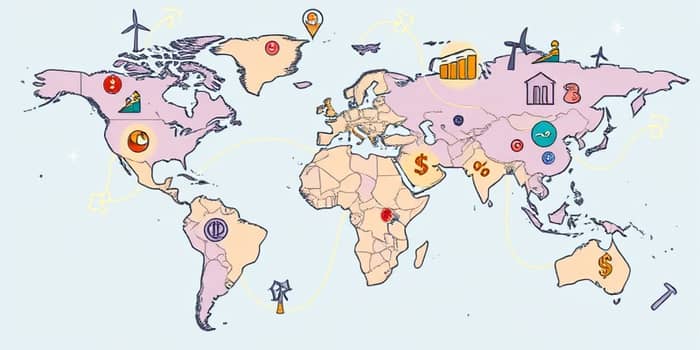
Investing across borders can seem daunting, but the rewards for those who embrace an international perspective are profound. By looking beyond domestic markets, investors can build portfolios that not only seek higher returns but also withstand localized shocks.
In this article, we explore the rationale, strategies, and real-world data behind global investing, with expert insights from 2025. Whether you’re a seasoned professional or just beginning, you’ll find practical guidance to diversify successfully.
Global diversification reduces reliance on a single market, offering a critical shield against downturns caused by political instability or sector-specific shocks. When investors focus solely on their home country, they expose themselves to concentrated risk. For instance, although the US accounts for 25% of the global economy, it represents 63% of global stock market capitalization—an imbalance that highlights widespread home-market bias among investors.
By spreading assets across developed and emerging markets, investors can tap into growth engines such as Asian technology hubs or renewable energy leaders in Europe. This approach can enhance returns by tapping into growth opportunities unavailable domestically, improving long-term wealth accumulation and resilience.
Modern portfolio theory underscores the power of combining assets with low or negative correlations. When one region underperforms, gains elsewhere can offset losses, resulting in smoother overall performance.
However, correlations among developed markets have risen, particularly during crises, slightly diminishing diversification benefits. In contrast, emerging and frontier markets maintain lower correlations, providing unique risk-adjusted advantages that many investors overlook.
Empirical research shows that international allocations can reduce overall portfolio volatility and risk. Additionally, holding assets in multiple currencies naturally hedges against inflation and currency depreciation, further boosting portfolio resilience against global shocks.
In 2025, several international markets delivered remarkable gains, reflecting both economic recovery and favorable currency movements:
Real estate also bounced back: global deal value climbed 11% to $707 billion in 2024, with data centers yielding 11.2% returns. Meanwhile, the US dollar’s decline boosted unhedged foreign equity returns for American investors.
Valuations remain attractive abroad. The MSCI ACWI (All Country World Index) trades at a forward P/E of 18.3x—near post-pandemic highs—but still below many US-centric benchmarks. Experts largely agree that non-US equities are poised to outperform over the next decade, driven by currency dynamics and lower starting valuations.
Global growth forecasts for 2025 vary widely by region. According to the latest data:
Global foreign direct investment fell 11% to $1.5 trillion in 2024, reflecting cautious capital flows amid policy uncertainties. Meanwhile, world trade reached $33 trillion, underscoring the interconnected nature of modern economies.
Geopolitical factors—such as elections, regulatory reforms, and trade negotiations—can introduce volatility. Nevertheless, a globally diversified portfolio serves as an effective hedge, cushioning investors against localized political or economic disruptions.
Investors have a rich menu of asset classes to craft a balanced global portfolio:
Sector trends vary by region. Asia leads in technology and renewable energy innovation, while Europe offers stable utilities and healthcare franchises. Global trade growth also benefits logistics and industrial real estate, creating compelling opportunities for long-term investors.
Currency risk can be a double-edged sword. A falling home currency amplifies foreign returns, as seen in 2025 for US-based investors. By strategically holding multiple currencies, portfolios gain an additional layer of defense against inflation and monetary policy shifts.
Holding investments in different currencies can buffer portfolios against home currency declines, turning potential headwinds into tailwinds. Active currency management—or selective hedging—can optimize this powerful diversification tool.
Global investing presents unique hurdles that require careful navigation:
Working with experienced advisors or utilizing actively managed funds can help mitigate these challenges. Professional guidance ensures portfolios remain aligned with evolving global conditions and investor objectives.
Looking ahead, a broad consensus among strategists points to superior returns for non-US equities over the coming decade. Attractive valuations, demographic trends in emerging markets, and continued technological advancement support this view.
However, the investment landscape is dynamic. Monetary policies in the US, shifts in Chinese growth trajectories, and regulatory reforms across Europe will shape relative performance. Investors must actively monitor policy, currency movements, and sector-specific developments to capitalize on emerging opportunities.
By embracing a global mindset—balancing risk and reward across geographies and asset classes—investors can craft portfolios that not only seek higher returns but also deliver long-term wealth preservation and resilience.
Conclusion: Global investing is more than a strategy; it’s a philosophy of openness to diverse growth stories and risk mitigants. Whether your goal is retirement security, intergenerational wealth transfer, or pure capital appreciation, expanding your horizons can build a stronger, more adaptable portfolio. Start today by evaluating your home bias, exploring international vehicles, and engaging expert advice to navigate the complex yet rewarding world of global markets.
References