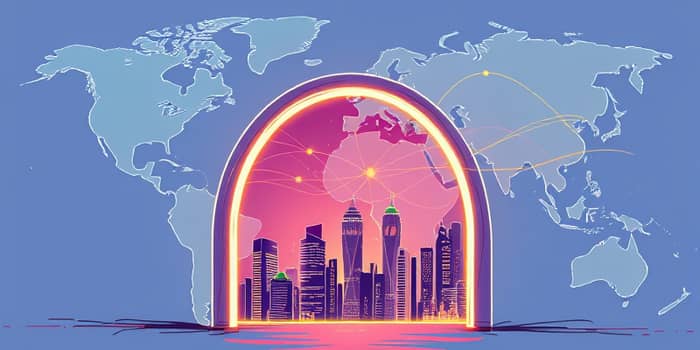
Imagine standing at the threshold of a world where borders blur and opportunities expand beyond imagination.
Gateway markets are not just cities; they are beacons of global connectivity that unlock doors to prosperity and innovation.
These strategic hubs, like New York or London, serve as primary entry points for investors and businesses seeking growth in an interconnected world.
In today's volatile economy, understanding how to navigate these markets can transform your vision into tangible success.
This article explores the essence of gateway markets, their benefits, and the strategies to thrive beyond your current horizons.
Gateway markets are major, strategically located metropolitan areas that act as primary entry points into broader regional or international economies.
They feature high liquidity, developed infrastructure, and economic stability that attract global talent and investment.
Examples include cities with robust financial sectors, cultural vibrancy, and consistent demand for real estate and services.
These markets are characterized by their resilience during downturns and their ability to foster innovation through diverse industries.
By serving as hubs for trade and commerce, they create a ripple effect that benefits entire regions.
Gateway markets offer a wealth of advantages for global businesses and investors.
Their infrastructure, including international airports and seaports, facilitates the seamless movement of goods and people.
This connectivity is crucial for accessing larger markets and reducing operational barriers.
Real estate in these areas is highly competitive, with low cap rates of 3-4%, indicating stable, long-term gains.
However, risks include high costs and limited upside compared to emerging markets, requiring careful planning.
Investment appeal stems from liquidity and diverse opportunities that foster innovation and cultural exchange.
The global economy is projected to slow to 2.6% growth in 2025-2026, down from 2.9% in 2024.
Trade volume growth is expected to decelerate to 0.6% in 2026, reflecting underlying volatility and challenges.
Despite this, selective gateway markets present opportunities due to their resilience and strategic importance.
US trade data from September 2025 shows exports at $289.3 billion, a 3.0% increase, while imports rose slightly to $342.1 billion.
The trade deficit narrowed to $52.8 billion, indicating shifts in global dynamics.
Tariffs and geopolitical disputes are reshaping trade flows, with US tariffs expected to rise to 14% by end-2025.
This may impact exporters and increase insolvencies, but gateway markets offer a buffer through their diversified economies.
Financial conditions now rival real activity in importance, with over 90% of trade relying on finance.
Key sectors like pharmaceuticals and industrial supplies show growth, driven by digital advancements and AI.
To expand globally, leveraging gateway markets is essential for tapping into broader networks.
Use these hubs as springboards for market entry, accessing skilled labor and foreign direct investment.
The EU Global Gateway Initiative, with €300 billion in investments, aims to enhance digital, energy, and transport infrastructure.
This model promotes quality infrastructure and rule of law, fostering sustainable growth.
Diversification is key amid economic slowdowns, with stable hubs in the US and EU offering reliable platforms.
By integrating into these networks, businesses can innovate and scale efficiently.
Gateway markets provide the foundation for long-term strategic growth, reducing exposure to localized risks.
The future of global trade is marked by volatility, but gateway markets stand as pillars of stability.
Their ability to adapt to economic shifts makes them ideal for sustainable investment and business expansion.
To capitalize on these opportunities, start by assessing your current position and identifying compatible gateway cities.
Embrace digital transformation and AI, as these technologies are reshaping short-term trade and creating new avenues.
Remember, the journey beyond borders begins with a single step into a gateway market.
By focusing on resilience and strategic partnerships, you can unlock a world of possibilities and drive impactful change.
Let this be your guide to navigating the complexities of global economics with confidence and foresight.
References