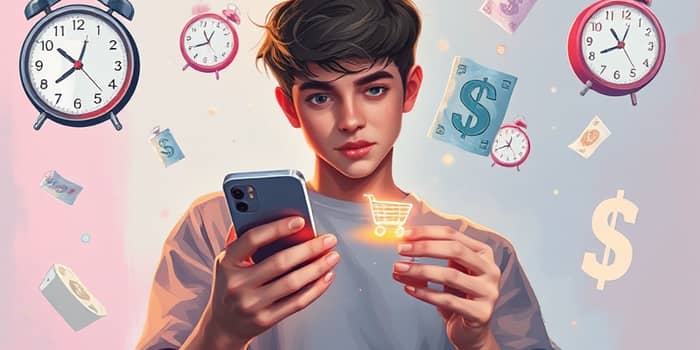
In an era of instant digital gratification, 'Buy Now, Pay Later' (BNPL) services have revolutionized shopping, weaving themselves into the fabric of consumer culture. Psychological biases drive our decisions subtly, turning BNPL from a mere payment option into a behavioral phenomenon that taps into our deepest instincts.
This article delves into the intricate mechanics behind BNPL, exploring how cognitive quirks shape spending and offering practical guidance to navigate its allure responsibly. By understanding the psychology at play, you can harness BNPL's benefits while safeguarding your financial well-being.
Financial literacy can empower users to make informed choices, transforming potential pitfalls into opportunities for mindful consumption. Let's embark on a journey to uncover the hidden forces driving this financial trend.
BNPL has surged from a niche innovation to a global powerhouse, with staggering market data underscoring its rapid adoption. The global BNPL market was valued at USD 492.8 billion in 2024.
It is projected to grow 13.7% to USD 560.1 billion in 2025. Through 2030, a compound annual growth rate (CAGR) of 10.2% is expected, reaching USD 911.8 billion.
Alternative estimates suggest USD 23.37 billion in 2025, growing at a 15.18% CAGR to USD 83.36 billion by 2034. The Asia Pacific region holds a dominant 36.42% share in 2024.
In the United States, the market is smaller but expanding swiftly. From USD 4.31 billion in 2024, it is forecasted to reach USD 5.04 billion in 2025.
By 2034, it could hit USD 21.41 billion at a 17.38% CAGR. Monthly BNPL spending in the U.S. rose 21% from June 2025, reflecting its growing influence.
User adoption is poised to hit 900 million globally by 2027. This growth isn't just economic; it mirrors deep-seated psychological drivers that BNPL expertly exploits.
BNPL services tap into fundamental cognitive biases, making them irresistibly appealing by aligning with how our brains process rewards and risks. Temporal discounting and present bias cause consumers to overvalue immediate gains.
We perceive four $25 payments as cheaper than one $100 payment, despite their equivalence. This bias, known as hyperbolic discounting, accelerates consumption while delaying payment utility.
Pain of paying reduction is another critical mechanism. BNPL disaggregates purchase pleasure from payment pain, creating psychological distance.
Drazen Prelec's concept explains how this separation makes spending feel less consequential. We enjoy the buy now without immediately feeling the pay later.
Choice architecture and nudges position BNPL as the default option at checkout. This exploits default bias and frames it as a standard payment, not financing.
Loss aversion is triggered through messaging that suggests avoiding missing out. Kahneman and Tversky's work highlights how this influences decisions.
The Theory of Planned Behavior (TPB) provides a framework. Attitudes toward BNPL, such as convenience, drive usage along with subjective norms.
Social endorsement and perceived control, like easy repayments, are key factors. Financial literacy moderates this control, enhancing or reducing negative outcomes.
Herd effect and convenience appeal strongly to young and low-income users. Social proof and frictionless payments make BNPL attractive.
Instant gratification and impulsivity are heightened, deferring consequences and boosting impulse buys. These biases align with cognitive mechanisms in behavioral finance.
BNPL significantly alters spending habits, with both positive and negative effects on consumer decisions. Research shows it increases purchase likelihood from 17% to 26%.
It boosts spending volume and frequency, encouraging more frequent purchases. HBR studies indicate changes in spending patterns toward higher frequency.
Impulsive buying is rampant, especially among youth. 75% of users prefer BNPL over credit cards, with Millennials and Gen Z dominating adoption.
This leads to financial strain via debt accumulation. Low-income and younger users are most vulnerable to this risk.
Demographics play a crucial role in understanding these impacts. Younger consumers, such as Gen Z and Millennials, are targeted and more susceptible.
Low-income individuals face higher risks of debt. Gender and other factors vary by region, often driven by promotions and social norms.
In developed markets, BNPL is used for high-value items like electronics. In emerging markets, it often covers essentials, driven by financial inclusion goals.
Qualitative insights reveal that BNPL alters decision-making and perceived affordability. Consumers feel they can afford more, leading to overspending and altered financial habits.
While BNPL offers convenience, it carries significant risks that can undermine financial stability. It promotes financial difficulties through overspending and debt accumulation.
Younger and low-income users are hit hardest by these pitfalls. Weakens long-term financial habits, as cognitive biases exacerbate poor decisions.
Mental health links are concerning. Easy credit fuels emotional spending, and poor financial literacy compounds the issues.
CFPB data from 2022-2023 shows trends in defaults and overuse by major providers. NY Fed experiments indicate demand driven by flexibility but risks hidden costs.
Mitigating factors include financial literacy. Enhanced control reduces negatives, as per the Theory of Planned Behavior, helping users navigate risks wisely.
To protect yourself, be aware of these risks. Set budgets and avoid multiple BNPL plans simultaneously to prevent debt spirals.
Behavioral finance provides the backbone for understanding BNPL. Cognitive biases like impulsivity and present bias underpin decisions.
The TPB conceptual model illustrates how attitudes, norms, and control lead to BNPL use. This affects behavior and financial stability.
Financial literacy moderates this relationship. Psychological contract reframing, as Dan Ariely notes, presents BNPL as convenience, not debt.
This reframing makes it more appealing by altering perceptions. By recognizing these frameworks, we can better navigate the psychological traps.
Key players like Klarna, Afterpay, Affirm, and PayPal dominate the BNPL landscape. Regional providers such as Tamara and MercadoPago are also significant.
Integrations with platforms like Amazon and Shopify boost accessibility. Super apps like Grab incorporate BNPL for seamless shopping experiences.
Trends include AI credit management, ESG-focused "green BNPL," and expansion to essentials and services. Marketing often targets youth via social norms.
KPIs for analysis include GMV trends, transaction volume, sales uplift by category, and consumer attitudes. Regional shares and adoption rationale are crucial metrics.
Regulatory challenges vary across regions. CFPB monitoring in the U.S. aims to ensure compliance and protect consumers from potential abuses.
To harness BNPL benefits without falling into traps, adopt mindful strategies that prioritize financial health. Start by understanding your financial situation thoroughly.
Set clear budgets and limits before using BNPL. Only use it for planned purchases, not impulse buys, to maintain control.
Monitor your BNPL accounts regularly. Avoid stacking multiple payments, as this can lead to debt spirals that are hard to escape.
Enhance your financial literacy through education. Learn about interest rates and terms, even if BNPL often has no interest.
Use BNPL for essential or high-value items when cash flow is tight. But ensure you can afford the repayments without strain.
Consider alternatives like savings or traditional credit if better suited. Always read the fine print and understand any hidden fees.
By being proactive, you can make BNPL work for you. It's about balancing convenience with responsibility for a secure financial future.
BNPL is here to stay, shaped by deep psychological currents that influence our daily choices. By embracing awareness and practical steps, you can shop smarter and build resilience against financial stress.
References