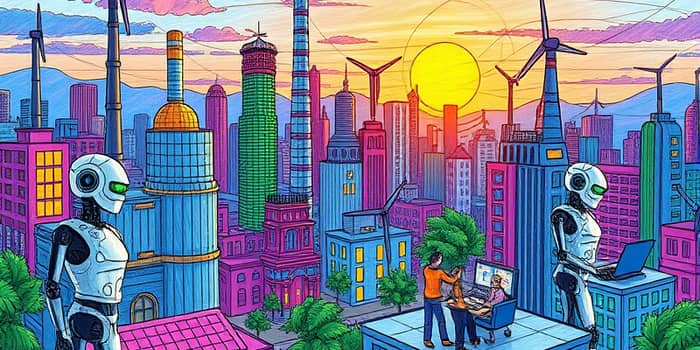
The business world is evolving at a breakneck pace, where strategies must adapt in months, not years.
Post-2020, we have entered a period of rapid and relentless change that demands immediate action.
Industries are being redefined by trends that go beyond mere shifts to become fundamental transformations in operations.
This article explores the key drivers set to revolutionize sectors from technology to manufacturing.
By understanding these trends, businesses can not only survive but thrive in the coming years.
Artificial intelligence is no longer a futuristic concept but a present-day necessity.
By 2026, the AI market is projected to reach $621.19 billion, highlighting its explosive growth.
AI enhances operational efficiency through tools like generative AI and predictive analytics.
These technologies automate tasks in logistics, finance, and healthcare, reducing waste and risks.
Smarter infrastructure, such as dense computing networks, supports this expansion.
However, challenges like data privacy and skills gaps require careful navigation.
Sustainability has moved from a niche concern to a core business driver.
ESG assets are expected to hit $33.9 trillion by 2026, underscoring its financial importance.
This trend is fueled by tightening regulations and increasing investor demands.
Companies that align with climate initiatives gain loyalty and reduce risks.
Political contradictions, such as varied state policies, add complexity to this alignment.
Embracing sustainability is not just ethical but essential for long-term growth.
The workforce is undergoing a profound transformation post-pandemic.
Remote-first and hybrid models are here to stay, prioritizing outcomes over location.
This shift enables access to global talent and enhances employee satisfaction.
Focus on wellbeing, including mental health resources, boosts retention and productivity.
Challenges like measuring ROI on wellbeing initiatives and preventing burnout persist.
Investing in people is a strategic imperative for future success.
Customers now expect tailored experiences at every touchpoint.
Data and machine learning make hyper-personalization scalable and effective.
AI-driven recommendations anticipate needs and drive higher conversion rates.
This trend extends to AI-generated social media content and automated communities.
Personalization fosters loyalty and differentiates brands in crowded markets.
Financial systems are being revolutionized by digital technologies.
Mainstream adoption of contactless payments, crypto, and blockchain is accelerating.
This enables faster cross-border transactions and new lending models through DeFi.
Examples include smart contracts and crypto acceptance in retail.
Embracing digital finance opens doors to new revenue streams and customer bases.
Businesses must balance global reach with local relevance in today's interconnected world.
Globalization 2.0 involves nearshoring and cultural adaptation for market entry.
Over 60% of firms report major disruptions in the past three years, highlighting the need for agility.
Context-aware AI helps tailor offerings to local markets effectively.
This approach ensures resilience and relevance in a fragmented global landscape.
To capitalize on these trends, businesses must adopt proactive and practical approaches.
Start by upskilling teams in AI and ESG through microlearning and targeted training.
Pilot AI projects in logistics or finance to test efficiency gains and scalability.
Build resilience by unifying data and securing supply chains against disruptions.
Embrace uncertainty as an asset, allowing for flexibility and innovation in planning.
By implementing these strategies, companies can not only adapt but lead in the transformative era ahead.
References