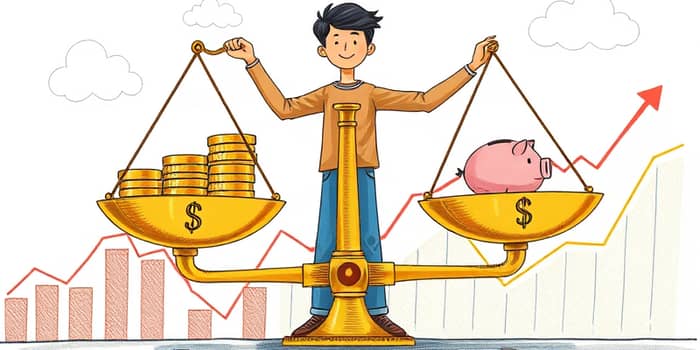
Interest rates influence every family budget, business plan, and personal goal. Understanding how they work can empower you to make informed decisions and take control of your finances.
Interest rates represent the price of borrowing money or the reward for saving/investing money. They are usually quoted as an annual percentage of the principal amount.
When you borrow, the lender charges interest to compensate for risk and opportunity cost. When you save, the bank pays interest to compensate you for deferring consumption.
Interest rates come in several forms, each with unique implications for borrowers and savers.
Loans—whether mortgages, car loans, student loans, or credit cards—all charge interest. Most consumer loans compound interest monthly, while credit cards may compound daily or monthly, driving up the cost of carrying balances.
Interest is calculated on the outstanding balance. Early payments often consist primarily of interest, while later payments reduce the principal.
For a mortgage of $200,000 at 5% for 15 years, you pay $84,685 in interest—over $36,000 more than at 3%. This huge difference over time highlights the power of rates on long-term debt.
Savvy savers seek the highest yields from bank accounts, term deposits, and certificates of deposit (CDs). In high-rate environments, returns of 3–5% are common; in low-rate periods, 1–2% may be the norm.
An investment of $1,000 at 3.5% for two years earns $70 in interest. While that may seem modest, compounding can grow your balance substantially over decades.
Simple interest is calculated only on the original principal, typically used in short-term loans. Compound interest is calculated on principal plus accumulated interest, common in savings accounts, mortgages, and credit cards.
Example: A $5,000 loan at 15% for five years with no payments grows to $10,535 with compound interest, compared to $8,750 with simple interest. This interest-on-interest effect shows why compounding works for savers and against borrowers.
Multiple forces drive interest rate levels:
Understanding these factors helps you anticipate rate movements and plan accordingly.
High interest rates make borrowing more expensive—mortgage payments rise, car loans cost more, and credit card balances balloon. Conversely, they boost returns on savings.
Low interest rates reduce borrowing costs, encouraging home purchases and refinancing but lower savers’ yields. Striking the right balance depends on your personal goals and time horizon.
Follow these actionable tips to optimize your finances:
Maintain a strong credit score to qualify for the best offers. Always ask for a breakdown of fees and tax implications before committing.
As a consumer, you are entitled to clear disclosures of interest rates, fees, and prepayment penalties. Compare multiple lenders and accounts to ensure you receive the best possible terms.
Use online calculators to simulate scenarios—borrowing costs and savings growth—and make data-driven decisions.
Interest rates shape every financial decision you make, from buying a home to growing your nest egg. By understanding key concepts—simple versus compound interest, fixed versus variable rates, and the factors driving rate changes—you can borrow responsibly and save wisely.
Regularly review your debts and investments, adapt strategies to current market conditions, and maintain healthy credit. This proactive approach will lead to long-term financial well-being and freedom.
References